

Introduction
Since the early days of humanity, meaning and purpose has been a fundamental to life and human existence. This article explores meaning and purpose from a developmental perspective, specifically the steps it takes to cultivate and develop purpose in our lives. This includes psychoeducation on meaning and purpose as well as exploratory exercises and worksheets to help define purpose in life.
Meaning and purpose are notoriously difficult to define. Philosophers, mystics, and spiritual traditions have offered enduring interpretations that have lasted a millennia. Much of eastern philosophy and mysticism states that the highest purpose in life is a journey towards transcendence, liberation from the ego/individual identity, desires, and attachments, leading towards the culmination of enlightenment, a state of union, oneness with all of existence. Transcendence and enlightenment are at the heart of meaning and purpose and is the ultimate remedy to human pain and suffering. From the western perspective, meaning and purpose often emphasize contribution: by aligning with something greater than oneself, such as family, community, work, competency, faith/spirituality/religion, etc, making a major impact and contribution towards these phenomena. Though distinct, these traditions converge beautifully. Both suggest that meaning and purpose give human will direction, helping us establish a rational base for life and guiding the virtues and values we choose to embody.
This framework views purpose as developmental-evolving through stages of curiosity, interest, passion, masatery and ultimately arriving at purpose. It is a process of aligning with competencies, roles, and values that serve both personal fulfillment and collective good.
Meaning and purpose is the antidote to human tendencies towards cynicism and nihilism.
Why Purpose Matters in Therapy
Clinically, purpose is a protective factor against cynicism, nihilism, and existential distress. It buffers against depression, burnout, and identity confusion. Each stage of development offers therapeutic insight:
- Curiosity may be suppressed in trauma or depression; restoring it signals healing.
- Interest supports motivation and behavioral activation in CBT.
- Passion fosters resilience and direction, especially in career or identity work.
- Mastery builds self-efficacy and consolidates identity.
- Purpose anchors meaning, often central in existential therapy, logotherapy, and post-traumatic growth.
Therapists can use this model to assess where a client may be “stuck” and tailor interventions accordingly.
Theoretical Foundations
This model echoes key psychological theories:
- Self-Determination Theory (Deci & Ryan): Purpose emerges through autonomy, competence, and relatedness.
- Maslow’s Hierarchy of Needs: Purpose aligns with self-actualization and transcendence.
- Flow Theory (Csikszentmihalyi): Mastery enables flow, where action and awareness merge.
- Logotherapy (Frankl): Meaning is essential to enduring suffering and finding direction.
These theories validate the developmental arc from playful exploration to meaningful contribution.
Cultural and Developmental Considerations
Purpose is shaped by cultural narratives and life stage. A teenager may explore purpose through identity formation, while an elder may express purpose through legacy and mentorship. Cultural values—such as collectivism or individualism—influence how purpose is defined and pursued
The Role of Values
Values act as a compass throughout this journey. They help filter which interests are worth pursuing and which passions align with deeper motivations. Purpose becomes sustainable when rooted in values that resonate across time and context.
Encouraging clients to identify and live by their values strengthens each stage of development and helps integrate purpose into daily life.
A Developmental Framework for Purpose
We tend to align purpose toward one or more of the following:
- Mastery of a subject matter or body of knowledge
- Skill or ability that serves a utility and benefits humanity
- A significant role (e.g., parent, friend, healer, creator)
Below are the five developmental stages of purpose, each with its own psychological conditions and reflective questions.
Below are the developmental stages mapped out to demonstrate how Purpose develops and evolves over time:
*The inside text of the pyramid list the requirements and conditions for the given stage. The outside text lists questions to establish, provoke and manifest the stage.
Stage 1: Curiosity
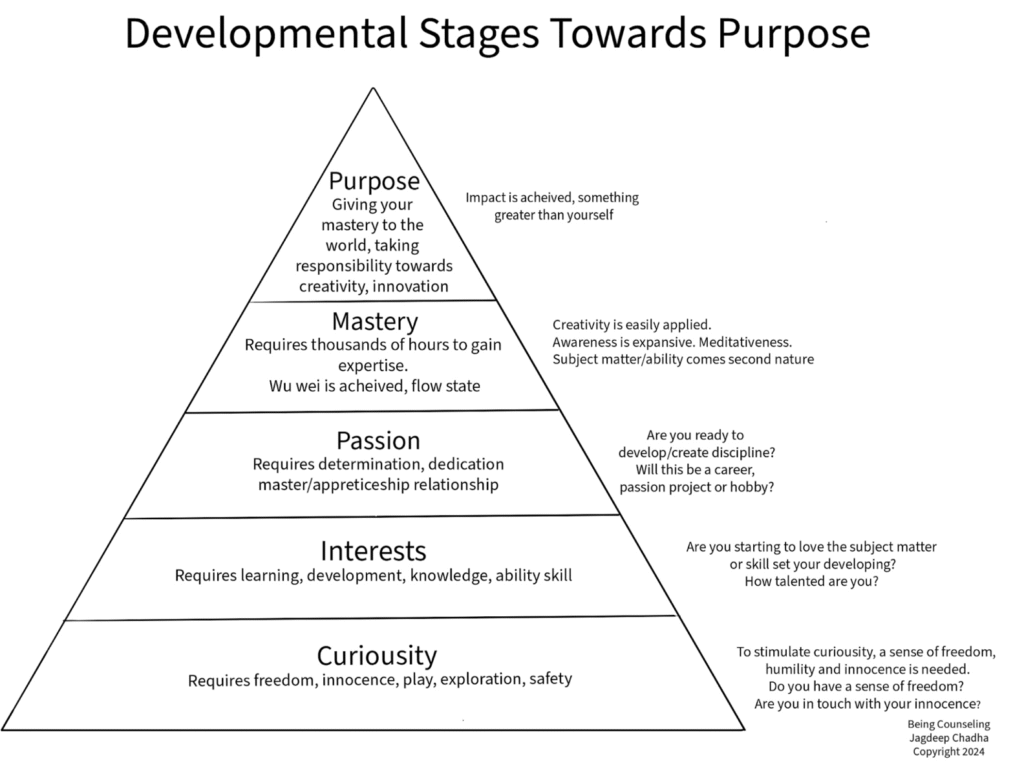
To stimulate curiosity, a sense of freedom, innocence and humility is needed. This is the key ingredient to learning and coming from a place where you can admit “I don’t know”, and I have a desire to learn, explore and find out.
- Conditions: Freedom, innocence, humility, safety
- Key question: “Do I feel free to explore without judgment?”
- Clinical note: Curiosity is often the first to vanish in depression or trauma. Reawakening it signals vitality.
Stage 2: Interest
Some curiosities die off as they are explored, and some turn into interests once a liking takes place, spending more time learning. The interest starts occupying the mind increasingly. An aptitude starts to develop and a talent may emerge.
- Conditions: Learning, development, skill-building
- Key question: “Am I starting to love what I’m learning?”
- Clinical note: Interest supports motivation and behavioral activation. It’s a bridge from passive to active engagement.
Stage 3: Passion
An interest turns into a passion when hundreds of hours are invested, a consideration starts to emerge, “can this be a career”, or “will this be a great passion project or hobby”. Dedication and determination come easy as the passion becomes a driving force and efforts made towards continuous learning and improvement come naturally.
- Conditions: Dedication, discipline, mentorship
- Key question: “Can this become a career, project, or lifelong pursuit?”
- Clinical note: Passion energizes identity work and long-term goal setting. It often emerges in adolescence and early adulthood, but can come later in life as well.
Stage 4: Mastery
Mastery of something normally takes thousands of hours to achieve. Once mastery is achieved, it feels like second nature. A sense of creativity towards the area of mastery emerges. Wu Wei, flow state is achieved due to the second nature element. Mastery is committed to the subconscious, to “muscle memory”, to the minds automated systems.
- Conditions: Thousands of hours, flow state, creativity
- Key question: “Does this feel like second nature?”
- Clinical note: Mastery builds self-efficacy and supports identity consolidation. It’s often a turning point in therapy.
Stage 5: Purpose
Purpose is achieved when you can give or share your mastery with the world, taking responsibility and share the innovation and creativity you have found and applied. When impact is achieved, there is a feeling of contributing to something greater than yourself, the feeling of “awe” or the “sublime”. Feeling like you are a drop in the ocean, part of something bigger than yourself, transcendence is achieved, a sense of oneness is experienced deep within.
- Conditions: Responsibility, contribution, awe, transcendence
- Key question: “How can I give this away?”
- Clinical note: Purpose anchors meaning and supports post-traumatic growth, legacy work, and existential integration.
Example Vignette
Mike, a 38-year-old electrician, had always enjoyed working with his hands but never thought much about purpose. After a period of burnout, he began reflecting on what used to spark his curiosity—fixing old radios with his grandfather. That memory led him to explore small electronics repair in his spare time. As his interest grew, he started volunteering at a local community center, teaching teens basic wiring and safety. Over time, this became a passion, and he began developing training modules and mentoring apprentices. Today, Mike feels a deep sense of purpose in passing on practical skills, helping young people build confidence and find stable careers.
Jasmine, a 32-year-old teacher, felt disconnected from her work. Through therapy, she rediscovered her curiosity for storytelling, which evolved into an interest in curriculum design. Over time, she developed a passion for trauma-informed education, eventually mastering the art of creating inclusive learning environments. Her purpose now includes mentoring new teachers and advocating for systemic change.
Purpose Development Worksheet
Instructions: This worksheet is designed to go through the process and development of purpose. It should help stimulate thought and formulate steps along the way. Work with your therapist if you have trouble with any sections.
- Current Snapshot
What feels meaningful right now:
What drains you or feels empty:
How I want my life to feel in 6–12 months (one sentence):
- Curiosity
Free-list activities, topics, experiences, skills that draw your attention:
1.
2.
3.
4.
5.
Freedom to explore new things (0–10): ____ /10
Where and when I feel playful or inquisitive:
Short exercise this week: Spend 60–90 minutes on one item above purely for play. Notes after session:
- Interest
Top 3 interests you returned to or want to learn more about:
1.
2.
3.
For each interest, fill these rows:
Interest 1: _________________________________________________________
• Why this matters to me: _______________________________________
• Skill/knowledge to gain in 4 weeks: ___________________________
• Hours per week I can commit: ______
Interest 2: _________________________________________________________
• Why this matters to me: _______________________________________
• Skill/knowledge to gain in 4 weeks: ___________________________
• Hours per week I can commit: ______
Interest 3: _________________________________________________________
• Why this matters to me: _______________________________________
• Skill/knowledge to gain in 4 weeks: ___________________________
• Hours per week I can commit: ______
Interest Readiness (for chosen interest): Not interested / Curious / Engaged / Committed
Circle one.
4-week micro-plan for one interest (3 concrete steps):
1.
2.
3.
- Passion
Which interest could become a passion and why:
Motivation when progress is slow:
Potential mentors or models:
Commitment checklist
• I can tolerate initial frustration to continue learning. Yes / No
• I have or can access resources to develop this. Yes / No
• I can protect regular practice time in my schedule. Yes / No
3-month practice contract (specific actions, frequency, measure):
Actions: ____________________________________________________________
Frequency: __________________________________________________________
Measure of progress: ________________________________________________
- Mastery
What mastery looks like for me (concrete description):
Milestones toward mastery (3–5 with approximate timelines):
1. Milestone: _________________________ Timeline: ____________________
2. Milestone: _________________________ Timeline: ____________________
3. Milestone: _________________________ Timeline: ____________________
Barriers and strategies (one barrier and one strategy per milestone):
1. Barrier: ___________________ Strategy: _____________________________
2. Barrier: ___________________ Strategy: _____________________________
3. Barrier: ___________________ Strategy: _____________________________
Flow and rituals that support practice (name 2–3):
1. __________________________ 2. __________________________ 3. _________________________
Weekly practice template to maintain for 6 months:
Days/times: ________________________________________________________
Main tasks each session: ____________________________________________
Duration per session: ______
- Purpose
Five ways I might share or apply my mastery to create impact:
1.
2.
3.
4.
5.
Impact statement (one sentence):
I use my __________________ to __________________ so that __________________.
Concrete role to start in next 6 months: ___________________________________
90-day outreach plan to test sharing one skill
• Goal: ___________________________________________________________
• First steps: _____________________________________________________
• Potential partners: _______________________________________________
• How I will measure impact: _______________________________________
- Values and Alignment
Top 5 core values (choose or write your own):
1. ______________ 2. ______________ 3. ______________ 4. ______________ 5. _______________
One behavior that demonstrates each value in daily life:
1.
2.
3.
4.
5.
Top 3 activities from earlier that align with these values:
1.
2.
3.
- Practical Planning Goals Metrics Accountability
SMART goal (fill one):
• Specific: _______________________________________________________
• Measurable: ____________________________________________________
• Achievable: _____________________________________________________
• Relevant: _______________________________________________________
• Time-bound: ____________________________________________________
Progress metrics (quantitative and qualitative):
Quantitative: _______________________________________________________
Qualitative: _______________________________________________________
Accountability partner or system: Name: __________________ Contact: ______ How often check-in: ____
Reward and rest plan: Weekly reward: __________________
Monthly restorative practice: __________________
- Obstacles and Coping Plans
Five likely obstacles:
1.
2.
3.
4.
5.
Coping strategy for each obstacle:
1.
2.
3.
4.
5.
If stuck, three quick actions to regain momentum:
1.
2.
3.
- Weekly Reflection
What I explored this week: _______________________________________
What energized me: _____________________________________________
What drained me: _______________________________________________
One small win: _________________________________________________
One lesson and next change: _____________________________________
Next week’s focused action: ______________________________________
- Monthly Review
Progress summary: _______________________________________________
What moved forward: ____________________________________________
What stalled and why: ___________________________________________
Adjustments to milestones, rituals, or goals: _______________________
Decision: Continue / Pivot / Pause Rationale: _______________________
- Personal Purpose Statement
Template: I cultivate [skill or quality] driven by [value or motivation] so I can [contribution or impact] for [who or what].
My purpose statement:
Use this worksheet as a living document. Revisit Curiosity when rigid, Interest when exploring, Passion when committing, Mastery when building habits, and Purpose when ready to share your work.
