
The Distinction Most Therapy Skips
In twenty-two years of practice, I have noticed a pattern that surprises most of my high-performing clients when I first name it: they have strong self-confidence and almost no self-worth.
These are not the same thing. And confusing them — which nearly everyone does — keeps some of the most capable people I know stuck in a loop they cannot explain.
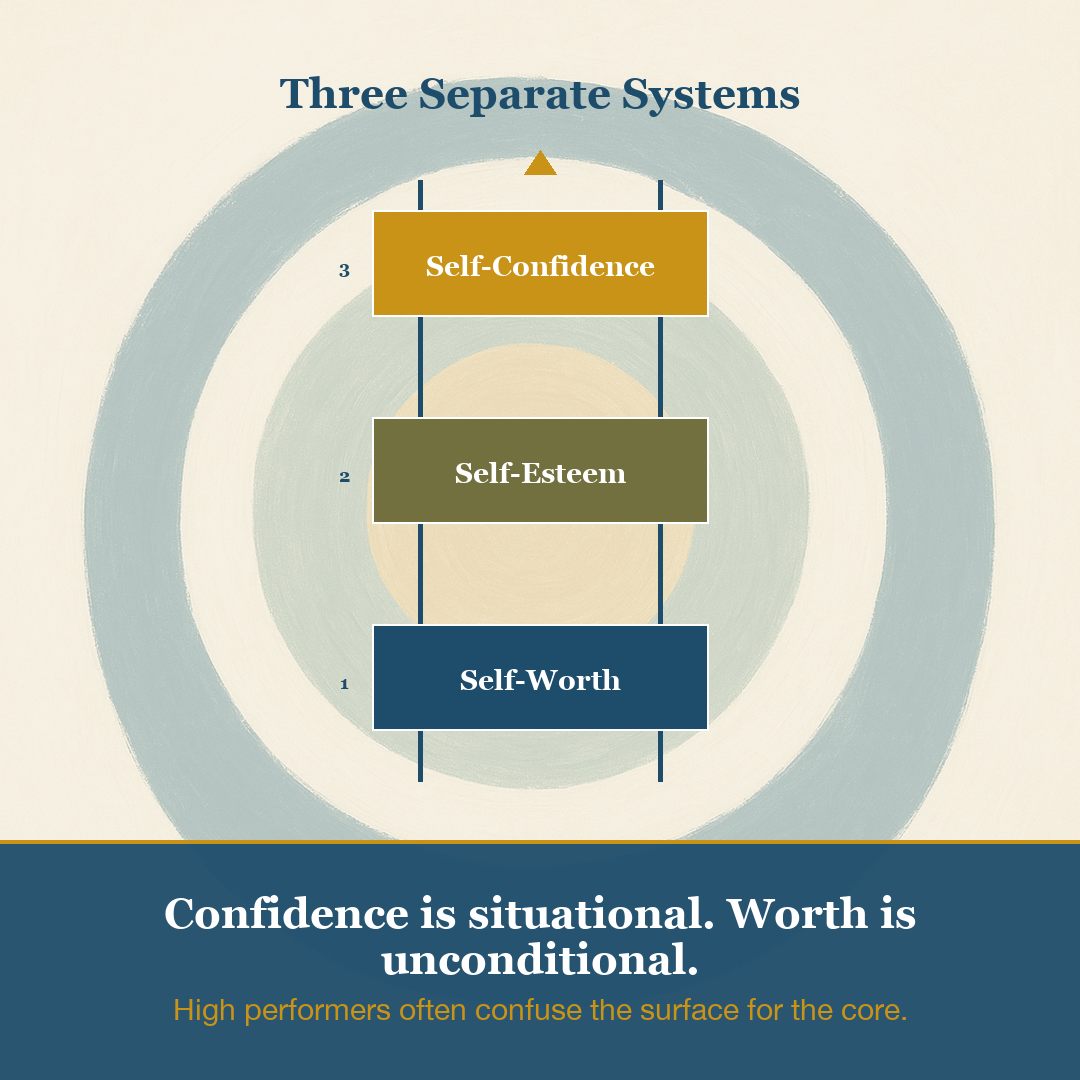
Three Separate Systems
Let me define these terms precisely, because the distinctions matter.
Self-confidence is your belief in your capacity to perform specific tasks. It is earned. It accumulates with practice, feedback, and evidence. A surgeon who has completed 2,000 procedures has high self-confidence in the operating room. A litigator who has won twenty jury trials has high self-confidence before a jury. This is functional and healthy — and most of my high-performing clients have it in abundance.
Self-worth is something different. It is your sense of inherent value — not because of what you produce, not because of your title or income or family approval, but simply because you exist. Self-worth is not earned through performance. It cannot be promoted, fired, or retired. It is the quiet bedrock underneath everything else.
Self-esteem sits between them. It is your general evaluation of yourself — your overall sense of whether you are a person of value, competence, and good character. Self-esteem is influenced by both self-confidence and self-worth, which is why it fluctuates more than either one in isolation.
In my clinical work, I use a simple metaphor: self-worth is the foundation, self-esteem is the frame, and self-confidence is the roof. You can have an impressive roof and a strong frame, but if the foundation is cracked, the entire structure is under stress — even when it looks fine from the street.
What Depleted Self-Worth Looks Like in High Performers
When self-worth is depleted, self-confidence becomes a defense mechanism rather than a foundation. The pattern is recognizable:
- High performers who cannot stop working, even when they want to, because stopping feels like disappearing
- Executives who accept every compliment with a quiet internal disclaimer — “they don’t know what I know about myself”
- Professionals who have achieved everything on the list and feel, privately, that none of it counts
- Leaders who can confidently manage a crisis but cannot tolerate a quiet evening without anxiety creeping in
The inner voice in these cases is not saying “I’m bad at my job.” It is saying something closer to: “My worth is contingent. If I slow down, they will find out. The only safe position is to keep performing.”
This is not a productivity problem. It is a self-worth problem wearing the costume of ambition.
The Inner Voice Is the Diagnostic Tool
In the framework I use with clients — drawn from the book I am completing, The Witnessing Voice — the inner voice is not the problem. It is the diagnostic instrument. What the inner voice says, and when, and to whom it directs its critique, tells us which layer is under pressure.
A client who says “I am terrible at this presentation” after a strong performance is probably speaking from depleted self-esteem. A client who says “I don’t deserve to be here, regardless of how the presentation went” is speaking from depleted self-worth. The intervention is different in each case.
One of the first exercises I use is deceptively simple: I ask clients to notice what their inner voice says when things go well. Most people have spent considerable time analyzing what they say to themselves when they fail. Very few have examined what happens when they succeed.
If success is met with relief rather than satisfaction, the inner voice is running a contingency loop — “I survived this one.” That loop is the signature of self-worth work, not self-confidence work.
A Starting Practice: The Threefold Self Check-In
I designed this brief audit for clients beginning the inner voice work. You can try it now:
- Self-confidence check: In what domain do I feel genuinely capable? What has my performance history confirmed? (This is where most high performers have clarity.)
- Self-esteem check: How do I feel about myself as a person — not as a professional, parent, or partner — today? Notice whether the answer shifts when you remove the role labels.
- Self-worth check: What would remain of my sense of value if I could not work, produce, or perform for the next six months? Sit with that. Don’t rush to reassure yourself.
Most high performers find questions one and two accessible. Question three produces either a quiet discomfort or a blank — which is itself information worth exploring.
Why This Matters for the Work We Do Together
Therapy that targets self-confidence when the real issue is self-worth tends to produce capable, efficient, still-exhausted people. The technical skill improves. The underlying static does not.
In my concierge practice, I work with one client at a time, which means I have the space to make this distinction carefully rather than defaulting to a protocol. The inner voice work — the belief audit, the threefold self check-in, the witnessing practices — is designed to reach the level where the actual disruption lives.
If you recognize yourself in any of the patterns above and you are ready to look at the foundation rather than just the roof, I am accepting a small number of new clients this spring.
Learn more about concierge therapy at beingcounseling.com
Jagdeep Chadha, LPC, M.A., Ed.M. is the founder of Being Counseling, PLLC in Houston, Texas, and the author of the forthcoming book The Witnessing Voice: Eastern Wisdom and Modern Psychotherapy for Inner Freedom.
