
Most people think gratitude is a feeling. It’s not.
Gratitude is a practice. And like all practices, it has a structure. When you miss that structure, gratitude journals fail. Meditation apps collect dust. You say “thank you” and nothing changes.
But when you understand the architecture of gratitude—when you know that each form addresses a specific psychological wound—gratitude becomes a rebuilding tool, not a platitude.
Why Gratitude Fails
I spent years watching clients do gratitude wrong. They’d journal: “I’m grateful for my family.” Nothing shifts. They’d meditate on abundance. Still flat. They’d force positive thinking. Still anxious.
The problem wasn’t their effort. It was their focus.
Most people’s gratitude practice hits maybe two forms. The others stay invisible. And without all seven, the foundation stays cracked.
This is the clinical reality: gratitude addresses different deficits depending on which form you practice. Miss one, and you’re trying to rebuild a house while leaving holes in the floor.
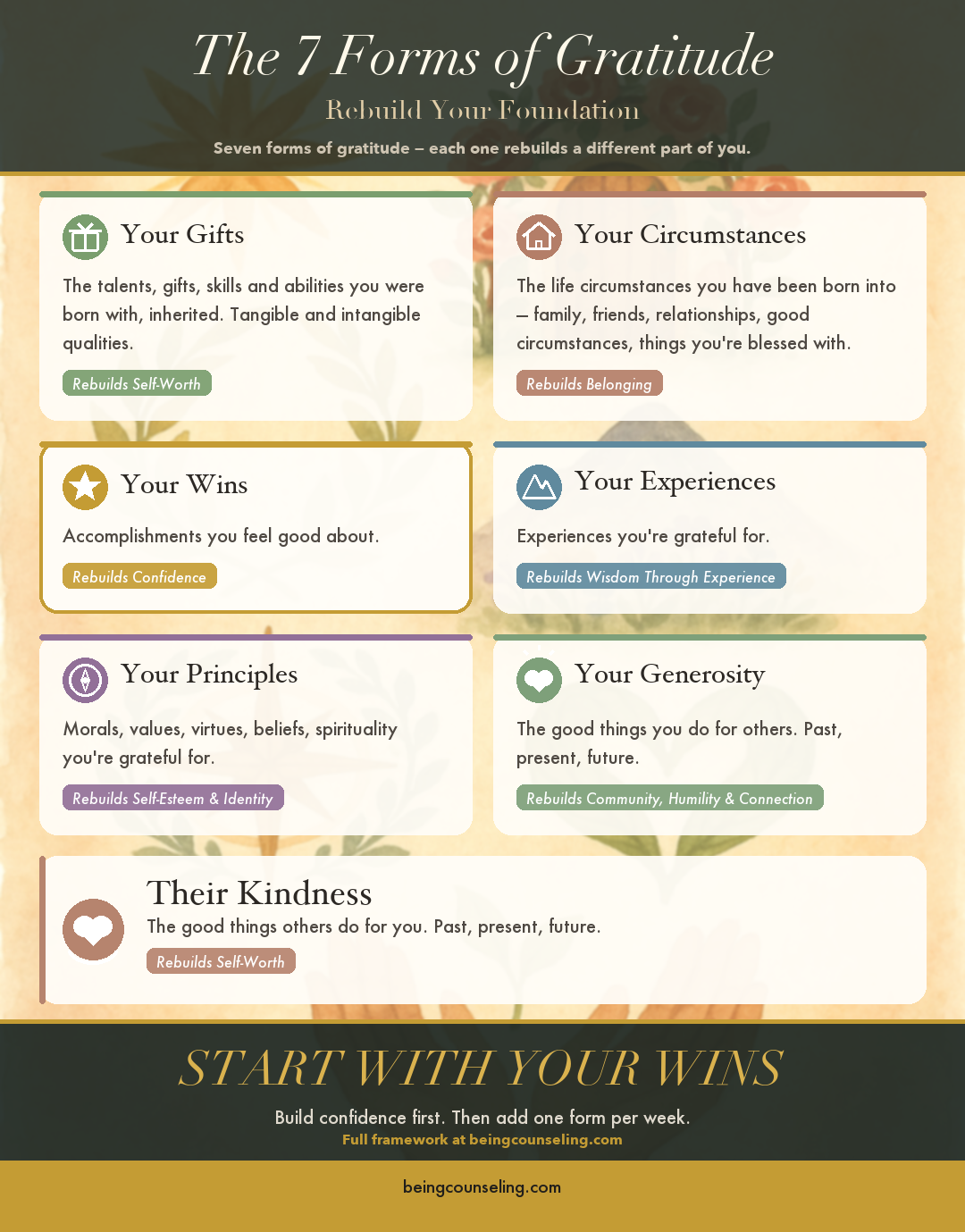
The 7 Forms of Gratitude
1. Your Gifts
The talents, skills, abilities you were born with. Not earned. Inherited. The tangible (your hands, your mind, your voice) and the intangible (your sense of humor, your intuition, your capacity to listen).
Most high performers never stop here. They’re always looking at what they lack, not what they have.
What this rebuilds: Self-worth. When you can name three real gifts without immediately downplaying them, you begin to feel inherently valuable—not because of what you do, but because of what you are.
2. Your Circumstances
The family, friends, relationships, location, luck you landed in. The blessing of simply being born into this particular life. Not everyone gets parents who show up. Not everyone grows up in safety. Not everyone has even one person who believes in them.
What this rebuilds: Belonging. Even if your circumstances were imperfect, recognizing what was good rewires your nervous system from “I’m alone” to “I was held.”
3. Your Wins
The accomplishments. The things you did and feel genuinely proud of. Not the Instagram wins. Not the performance wins. The real ones.
What this rebuilds: Confidence. Real confidence isn’t about competence. It’s about evidence that you can act despite doubt. Every genuine win is neural data: “I did the hard thing once. I can do it again.”
4. Your Experiences
The moments that taught you something. The hard ones especially. The grief that deepened you. The failure that made you humble. The loss that made you grateful for what remains.
What this rebuilds: Wisdom. When you can look back and say “that taught me,” you move from victim to learner. Your past becomes curriculum, not curse.
5. Your Principles
The morals, values, virtues, beliefs, spirituality you actually live by—not the ones you claim. Honesty. Courage. Compassion. Integrity. Faith. Purpose.
What this rebuilds: Identity. Identity no longer depends on what you have or what you do. It depends on what you stand for.
6. Your Generosity
The good you’ve done for others. Past, present, future. The time you spent listening when someone needed you. The help you gave without expecting return. The way you’ve shown up.
What this rebuilds: Connection and humility. When you’re grateful for your own generosity, you stop waiting to “earn” your place in the world. You recognize you already belong.
7. Their Kindness
The good others have done for you. The times someone showed up when you couldn’t show up for yourself. The grace you were given. The people who believed in you before you believed in yourself.
What this rebuilds: Reciprocal self-worth. This form closes the loop. You’re not just a giver. You’re someone worthy of being given to.
How to Use This Framework
Don’t try all seven at once. That’s overwhelm disguised as ambition.
Start with Form 3: Your Wins. This is the one most high performers avoid. It’s where confidence is rebuilt. You need this foundation first.
Spend a week on that one. Let your nervous system process: “I have done hard things. I am capable.”
Then move to Form 1: Your Gifts. Ground yourself in what you have that doesn’t depend on performance.
Then the others, one by one.
This isn’t positive thinking. This isn’t toxic optimism. This is clinical work. Each form addresses a specific psychological need. When all seven are woven together, you’ve rebuilt something solid.
The goal isn’t to feel happy. The goal is to feel grounded. To know, in your body, that you are enough—not because of what you do or have or achieve, but because you exist, you’ve learned, you’ve given, and you’ve been given to.
If you want to go deeper—if you want to work with these seven forms in a structured way across three months—reach out. I work with high performers who are ready to rebuild their foundation, not just optimize the surface.
