
Where Are You Really Investing?
Most people have a financial portfolio they can describe in rough terms — stocks, cash, real estate, retirement accounts. They can tell you how it is weighted, where they are overexposed, and whether they have been paying attention to it.
Almost no one has mapped the emotional equivalent.
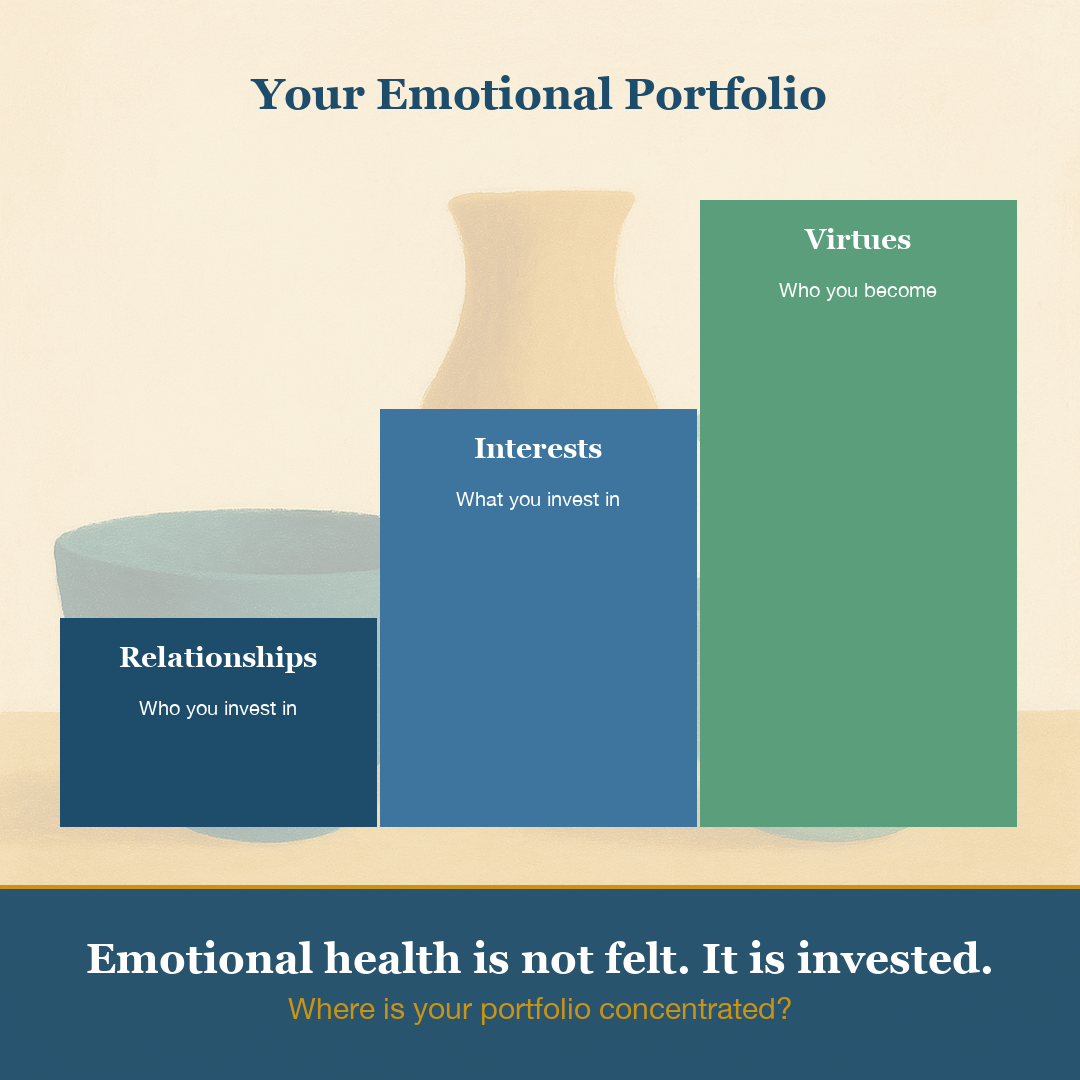
In my clinical practice, I use a framework I call the Emotional Portfolio — the sum of what you are investing your emotional energy in across three domains: your relationships, your interests, and your virtues. The distribution of that investment shapes nearly everything about your daily experience: your energy levels, your sense of meaning, your resilience when things go wrong, and the quality of your most important relationships.
Most people, when they map it honestly, find the portfolio is badly out of balance.
The Three Asset Classes
Think of your emotional energy the way a financial planner thinks about capital — finite, deployable, and subject to returns or losses depending on where it goes.
Relationships are the first asset class. Not just romantic partnerships — every significant relationship requires ongoing emotional investment. Some return warmth, growth, and resilience. Others drain steadily and return very little. The mistake most people make is not recognizing that unexamined relationship investments compound — in both directions.
Interests are the second. What activities, domains of learning, or creative pursuits receive your sustained engagement? Interests that align with your values and generate genuine absorption — what psychologists call flow — produce disproportionate returns on emotional investment. Interests maintained purely from obligation or social expectation tend to drain rather than renew.
Virtues are the third, and the most often overlooked. The practice of qualities like patience, honesty, courage, and compassion requires consistent investment — they do not maintain themselves. When virtue practice atrophies, the emotional portfolio becomes reactive: you respond to life from depletion rather than from an internal reserve.
The Problem With Emotional Over-Investment
The clinical pattern I see most consistently in high-functioning adults is not under-investment — it is over-concentration in one area at the expense of the others.
The executive who pours everything into professional relationships and achievement, leaving almost nothing for the relationships at home and no investment in personal interests or virtue development. The result, over time, is not simply burnout — it is a loss of the internal resources needed to sustain the performance that consumed them in the first place.
Or the person who over-invests in a single relationship — usually a romantic partnership or a fraught family connection — to the point where every fluctuation in that relationship registers as a threat to the entire system. Their emotional portfolio is so concentrated that a single loss can feel like total collapse.
The framework is not about eliminating concentration. Some seasons of life require heavy investment in a specific area. The question is whether the concentration is chosen or defaulted into — and whether you know what the rebalancing plan looks like when the season shifts.
The Attachment-to-Dependency Progression
One of the more important dynamics this framework surfaces is how healthy attachment can slide into emotional dependency — and how that progression typically goes unnoticed until significant damage is done.
It begins with appreciation: you value something or someone. Over time, appreciation can deepen into reliance — which is still healthy. You count on this person, this work, this practice. But if reliance is never examined, it can slide into need: the object of investment is no longer enriching life but maintaining baseline function. And if need goes unaddressed, it reaches the final stage: dependency, where the absence of the investment object produces crisis.
In clinical work, this progression shows up most clearly in relationships — but it operates equally in careers, substances, and even self-concepts. The person who has become dependent on professional achievement for their sense of self is as constrained by that dependency as someone dependent on a person. Both patterns require the same clinical intervention: a deliberate, graduated reinvestment in other areas of the portfolio.
Five Steps to Rebalance
When a client and I work through an emotional portfolio audit together, the rebalancing process typically follows five steps.
1. Map the current state honestly. Without judgment, identify where emotional energy is actually going — not where you intend it to go. This requires honesty about which relationships you are actively investing in versus maintaining on autopilot, which interests you are genuinely engaged with versus performing, and which virtues you are practicing versus assuming you have.
2. Identify the highest-return investments. Which relationships leave you more resourced than before? Which interests produce genuine absorption rather than obligation? Which virtues, when you practice them, strengthen your overall capacity? These are your anchors. They should receive protected investment regardless of external pressure.
3. Identify the draining positions. Where are you putting energy that consistently returns less than you put in? Not every draining investment should be exited — some are non-negotiable — but they should be named, budgeted for, and tracked. Pretending they don’t drain you is how depletion accumulates invisibly.
4. Design a reinvestment sequence. Small, specific, time-bounded. Not a resolution to invest more in everything at once — that is a recipe for demoralization. One relationship to tend more intentionally this month. One interest to re-engage for twenty minutes, three times per week. One virtue practice to bring into daily life. Reinvestment compounds slowly, like any portfolio rebalancing.
5. Review at intervals. The portfolio is not static. Life stages, professional transitions, relational changes — all of these shift the landscape. Building in a regular review (quarterly is realistic for most people) prevents the gradual drift back into unconscious over-concentration.
On Virtue as an Investment
The virtue component of this framework is worth addressing directly, because it tends to generate the most resistance.
Most adults in clinical practice have a complicated relationship with the concept of virtue — it carries moralistic weight, implies judgment, and sits uneasily in a therapeutic context that emphasizes non-judgment and self-compassion.
I use the term in a specific, non-moralistic sense: virtues are practiced capacities that strengthen the self’s ability to navigate difficulty. Patience is not a personality type. It is a practiced skill — the specific skill of regulating the urgency that wants you to react before the moment is ready. Courage is not a character trait. It is a practiced choice — taking the next right action in the presence of fear rather than waiting for fear to resolve.
When virtues are understood as practices rather than character judgments, the resistance typically softens. And the clinical benefit is significant: people who are actively practicing a virtue — any virtue — report more agency, more stability, and more capacity to navigate the inevitable reversals in other parts of their portfolio.
A Starting Point
If you want to begin mapping your own emotional portfolio, start with a single question for each of the three domains:
- Relationships: Which two or three relationships currently receive the most of my emotional investment? Am I satisfied with the return?
- Interests: What did I used to care about that I have quietly stopped making time for? What does that tell me?
- Virtues: Which quality — patience, honesty, courage, compassion, humility — am I most neglecting right now? What would practicing it look like this week?
These questions do not require a therapist to answer. But they often surface material that is worth working through with one.
If you are a Houston-area professional considering concierge therapy, I offer a limited number of engagements focused on exactly this kind of work — deliberate, depth-oriented, and built around your specific life. Initial consultations are available at beingcounseling.com.
Jagdeep Chadha, LPC is a licensed professional counselor in Houston, TX. He holds an M.A. and Ed.M in Psychological Counseling from Columbia University, Teachers College. He is the founder of Being Counseling, PLLC, and the author of the forthcoming book The Witnessing Voice: Eastern Wisdom and Modern Psychotherapy for Inner Freedom.
