
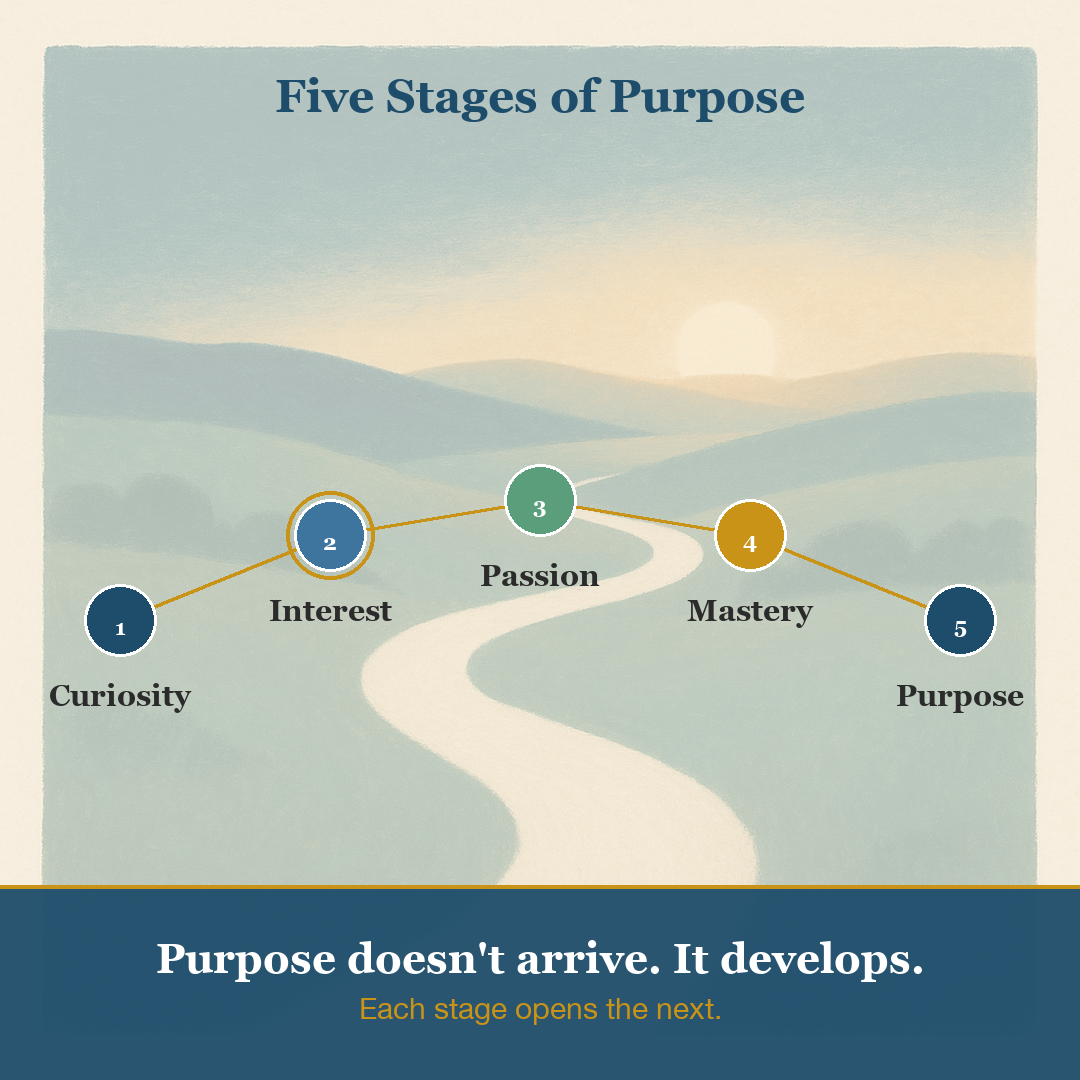
The Five Stages of Purpose: A Clinical Map From Curiosity to Contribution
Purpose is one of the most misunderstood concepts in both popular psychology and clinical practice. It is often treated as a destination — something you either have or lack — rather than a developmental process with distinct, predictable stages.
In nine years of clinical work, the most common presentation I see in high-performing adults is not depression or anxiety in isolation. It is a quiet sense of displacement: the feeling that something that used to matter no longer does, or that the next right move is invisible. The career is intact. The relationships are functional. But something essential has gone quiet.
In most cases, that silence is not pathology. It is a developmental signal. The person has completed one stage of purpose-building and has not yet found the entry point to the next.
What follows is the clinical map I use — a five-stage model of how purpose develops across a life.
Stage One: Curiosity
Curiosity is the biological foundation of purpose. It is not enthusiasm, excitement, or passion — those come later. Curiosity is quieter: a pull toward something without knowing why.
The conditions it requires are freedom, safety, and humility — specifically, the willingness to say “I don’t know” without that admission threatening your sense of self. Children operate in curiosity naturally. Adults have to reclaim it.
The clinical marker I watch for is its absence. Curiosity is the first faculty to vanish in depression and trauma. When a client tells me nothing feels interesting anymore, I am not primarily worried about motivation. I am tracking the disappearance of curiosity as a vital sign. Its return signals that something fundamental is coming back online.
The stage-one question: “Do I feel free to explore without judgment — including judgment from myself?”
Stage Two: Interest
Interest is curiosity with direction. It emerges when exploration meets sustained engagement — when you keep returning to something without being required to.
Interest is clinically significant because it does not require performance. You do not have to be good at something to be interested in it. This matters enormously in therapy: many high-achievers have been trained to pursue only what they are already competent at. Genuine interest requires tolerating the beginner state.
In CBT terms, interest is the bridge between passive and active engagement. It feeds behavioral activation before motivation arrives. You do not wait to feel interested — you act, and the interest deepens.
The stage-two question: “Am I starting to love what I’m learning, independent of how well I’m doing at it?”
Stage Three: Passion
Passion is interest that has survived friction. It requires hundreds of hours, mentorship, and the experience of difficulty without quitting. This is where most of the self-help literature goes wrong: passion is not discovered, it is built. It does not precede commitment — it follows it.
Clinically, passion energizes identity formation. When a client develops genuine passion for something, their narrative about themselves shifts. They gain language for who they are that is not borrowed from their job title or relationship status.
This stage is common in adolescence and early adulthood but can arrive at any point. I have worked with clients in their 50s who found their first real passion — and the experience was as alive and disorienting as anything they had known at 25.
The stage-three question: “Can this become a career, project, or lifelong pursuit — and am I willing to stay with it when the discipline is hard?”
Stage Four: Mastery
Mastery is the phase most high-performing adults inhabit when they arrive in my office. Thousands of hours invested. Second-nature competence. The work flows easily now. Others come to them for guidance.
And yet — something is missing.
The Daoist concept of wu wei is most accessible at mastery: effortless action, the feeling of skill operating without strain. This is what most people are reaching for when they speak about “flow.” Mastery makes it possible.
The clinical turning point at this stage is what I call the ceiling-of-mastery moment: when performance is no longer enough to organize a life around. The skills are real. The question they generate is uncomfortable: Is this all there is?
That question is not a symptom. It is the correct next question.
The stage-four question: “Does this feel like second nature — and am I ready to ask what it is for?”
Stage Five: Purpose
Purpose is what mastery looks like when it turns outward.
In Eastern frameworks, this transition has a name: the movement from sadhana (personal cultivation, self-refinement, practice) to seva (service, contribution, giving back). Every tradition that takes inner development seriously eventually reaches this question: how do I give this away?
Viktor Frankl called the healthy version of this orientation “dereflection” — a turn away from excessive self-focus toward meaning that exists in relation to others. His insight, developed in the most extreme conditions imaginable, was precise: the self finds meaning not by looking inward indefinitely, but by finding something worth contributing to.
Clinically, purpose anchors meaning, buffers depression and burnout, and supports post-traumatic growth. It gives the will something to organize around that is larger than the self.
The stage-five question: “How can I give this away — and to whom?”
Where Are You on the Map?
The most common clinical error I see — in clients, and occasionally in therapists — is trying to skip stages. The executive who has mastered finance but has never developed genuine curiosity about anything beyond performance. The therapist who has passion without enough mastery to hold the room. The early-career professional desperate for purpose before interest has had time to stabilize.
Each stage builds the substrate for the next. Curiosity makes interest possible. Interest makes passion survivable. Passion makes mastery achievable. Mastery makes purpose meaningful.
If you feel stuck, the most productive question is usually not “What is my purpose?” It is: “Which stage am I actually in — and what does this stage require of me?”
A Note on the Worksheet
In my practice and in my forthcoming book, The Witnessing Voice, I use a ten-section purpose worksheet that walks through each stage — including a personal purpose statement template:
“I cultivate [skill] driven by [value] so I can [contribution] for [who].”
It is a simple sentence. Writing it usually takes months of clinical work to make honest. But when it clicks, clients describe the same thing: a quiet sense that they know where they are going, and why it matters.
That is purpose. Not a headline. Not a brand statement. A direction that the self can actually commit to.
Jagdeep Chadha, LPC is a Houston-based psychotherapist and the founder of Being Counseling, PLLC. He holds a Master of Arts and Master of Education in Psychological Counseling from Columbia University, Teachers College, and brings nine years of clinical practice to concierge individual therapy. His forthcoming book, The Witnessing Voice: Eastern Wisdom and Modern Psychotherapy for Inner Freedom, integrates CBT, psychodynamic, and Eastern frameworks. Concierge consultations are available at beingcounseling.com.
