
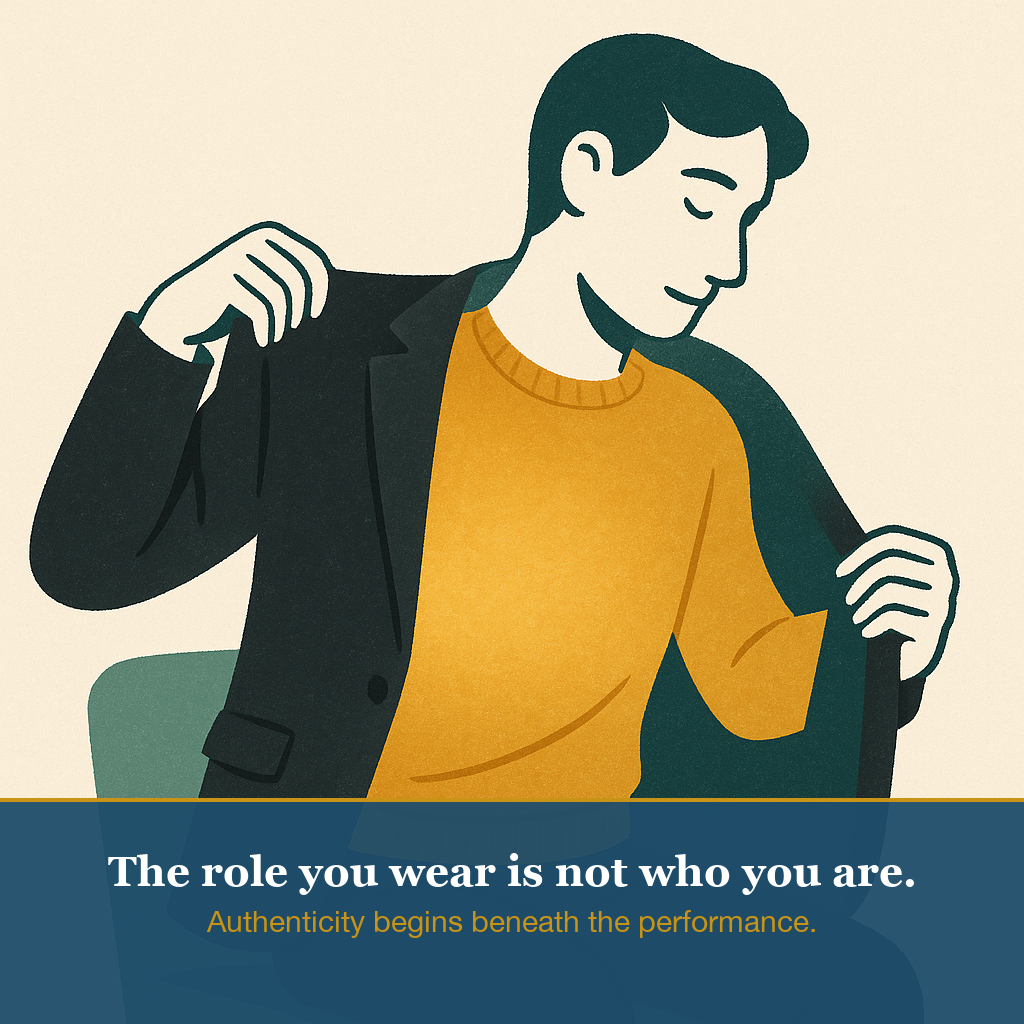
The Role You Wear Is Not Who You Are
There is a version of you that performs well under pressure. Another that softens around family. One that leads meetings with authority and another that defers when the stakes feel personal. Most people move between these versions so fluidly that they stop noticing the transitions.
That fluidity is not a problem. It is, in most cases, a sign of healthy social functioning.
The problem arrives when the role stops being something you wear and starts being something you are — when you cannot locate yourself outside of the performance, when threat to the role feels like threat to existence.
This is the clinical territory I work in most often with high-performing adults in Houston: not the presence of adaptive roles, but the fusion with them.
Three Ways We Over-Identify With What We Are Not
In my clinical practice, identity fusion typically forms around one of three things.
The first is what we desire but do not yet have. “When I make partner, I’ll feel complete.” “Once the relationship is stable, I’ll relax.” The future achievement becomes the anchor of present identity — which means the present self is always incomplete by definition. This is not ambition. It is a specific kind of suffering that disguises itself as motivation.
The second is what we have but could lose. Reputation. Health. Physical appearance. A title. The respect of people whose opinion matters. When these become the foundation of identity, the nervous system is perpetually scanning for threat. Anxiety, hypervigilance, and over-control are not personality defects in this case — they are the logical output of a system built on a fragile foundation.
The third is what others reflect back. “I am who the room says I am.” This is perhaps the most insidious, because it requires an audience to maintain the self. Approval-seeking, difficulty tolerating conflict, and people-pleasing are the clinical signatures of this pattern — not character flaws, but strategies developed to protect a self that has no other source of confirmation.
These Identities Were Adaptive First
This is the part that often gets missed in popular psychology: the mask was not a mistake.
Every role a person develops — The Performer, The Caretaker, The Expert, The Peacekeeper — was built in response to real circumstances. The child who learned that conditional love required exceptional achievement did not choose the Performer identity out of vanity. She built it because it worked. It secured something essential. Fusion is protective. It helped the client survive.
Therapy that treats the role as the enemy, something to be dismantled and discarded, misses this. The goal is not to destroy what someone built to get here. The goal is to loosen its grip enough that the person has a choice.
What the Inner Witness Sees
In the framework I use — grounded in my forthcoming book, The Witnessing Voice — the antidote to role fusion is not analysis or willpower. It is the cultivation of what I call the Inner Witness.
The Inner Witness is not a new faculty you develop. It is a part of the mind already present — the aspect that observes experience without being absorbed by it. Buddhism calls it sati. The ACT framework calls it the observer self. DBT calls it wise mind. Krishnamurti called it choiceless awareness. These traditions converge on the same phenomenon: the capacity to see what is happening without fusing with what you see.
One of the most clinically powerful lines I have ever offered a client came from this framework: “The awareness of your anger is not angry. The awareness of your fear is not fearful.”
That sentence does something precise. It creates distance — not dissociation, but genuine perspective. It reminds the person that they are the observer of the experience, not the experience itself. And in that small gap, something becomes possible that was not possible before: choice.
The Clinical Work: Loosening, Not Removing
I want to be specific about what this looks like in practice, because the Inner Witness is sometimes misread as a detachment practice — a way of not caring, not feeling, not being present.
It is the opposite.
When a client in my Houston practice can say, “I notice I’m performing right now, and I’m not sure I need to” — that is not detachment. That is a more intimate contact with reality than the performance ever allowed. The Performer identity was, paradoxically, a way of not being present — it required constant attention to audience response, to evaluation, to gap-management between the self presented and the self feared.
The witnessing awareness that emerges when the mask loosens is quieter, more settled, and more genuinely relational. People often describe it as “finally feeling like myself” — which is notable, because nothing in the external world has changed. Only the internal relationship to the role has shifted.
The clinical work proceeds in three phases:
First, recognition. Helping the client see which roles they inhabit, when the transitions happen, and what threat the role was originally built to manage. This is not blame or archaeology for its own sake — it is mapping.
Second, differentiation. Creating language and practice around the distinction between “I am doing this” and “I am this.” Role-shift rehearsals, the “I am witnessing this, but I am not this” practice, and journaling from the witnessing perspective are all tools I use here.
Third, integration. The role does not disappear. It becomes optional. The client can step into The Performer when performance is genuinely called for, and step out when it is not. Agency returns to the center.
A Question to Sit With
Most high-performing adults I work with are not confused about what roles they play. They know the masks. What they have lost is confidence that anything exists beneath them.
The therapeutic question I find most generative is not “Who are you really?” — that question can spiral into abstraction. The more useful question is:
What would you do differently if no one whose opinion you respect was watching?
That gap — between the public and private answer — is where the witnessing work begins.
On Working With This in Concierge Therapy
The clients I see in concierge practice in Houston are, almost without exception, skilled at role management. They have built careers on it. The mask is often polished, effective, and socially rewarded.
Which means the invitation to loosen it requires a particular kind of safety — one built on discretion, clinical depth, and a practitioner who is not impressed by the performance.
That is the environment I work to create.
If you are reading this and recognizing yourself in any of it — the fatigue of maintaining the role, the quiet question of what is underneath it — that recognition is worth paying attention to. It is not a crisis. It is information.
I offer a limited number of concierge therapy engagements for Houston-area professionals. Initial consultations are available at beingcounseling.com.
Jagdeep Chadha, LPC is a licensed professional counselor in Houston, TX. He holds an M.A. and Ed.M in Psychological Counseling from Columbia University, Teachers College. He is the founder of Being Counseling, PLLC, and the author of the forthcoming book The Witnessing Voice: Eastern Wisdom and Modern Psychotherapy for Inner Freedom.
