
Nobody decides to become emotionally dependent on another person. That is exactly what makes it so hard to catch. Dependence doesn’t announce itself. It arrives one reasonable step at a time, and every step feels like closeness rather than danger.
In my clinical practice, I’ve watched this same quiet progression play out in executives, partners, parents, and adult children. Different people, different relationships, the same five stages. Understanding them is one of the most practical forms of emotional self-defense I know — not because relationships are dangerous, but because the line between healthy love and quiet dependence is far thinner than most of us assume.
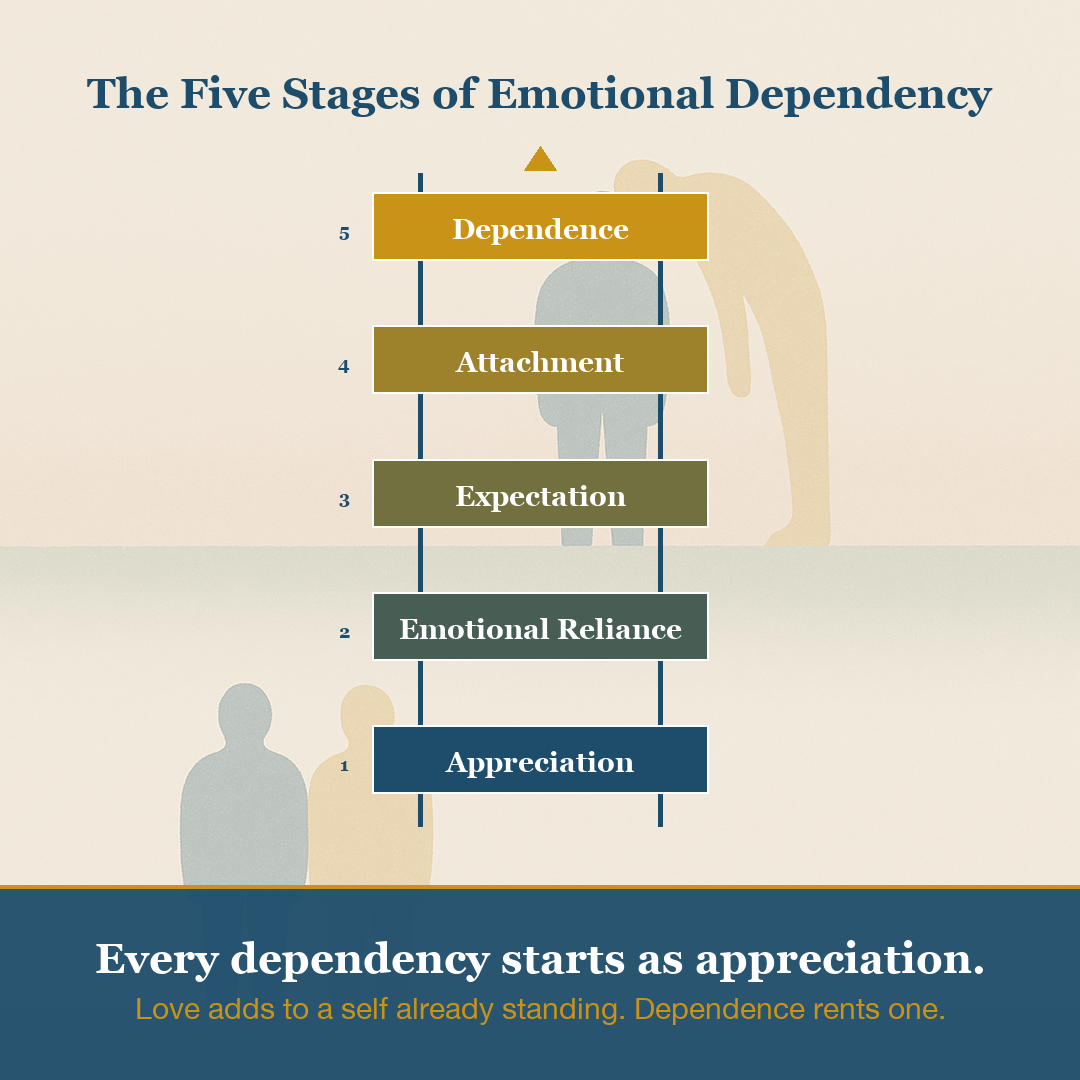
The Five Stages of Emotional Dependency
Each stage is built from the one before it. None of them is wrong on its own. The problem is drift — the slow handing-over of your internal stability to someone outside you, without ever noticing the moment it happened.
1. Appreciation
It starts here, and it starts well. You notice something real and admirable in another person — their steadiness, their warmth, their competence, the way they see you. Appreciation is the foundation of every good relationship. There is nothing to correct at this stage. But it is worth knowing that this is where the road begins.
2. Emotional Reliance
Appreciation becomes reliance when you start going to that person for validation. Their reassurance settles you. Their approval regulates you. You begin, subtly, to check your own worth against their reaction. This still looks like intimacy — and some of it is — but a quiet transfer has begun. Your nervous system is learning to outsource its calm.
3. Expectation
Reliance hardens into expectation when you begin to count on that validation arriving. What was once a gift becomes a requirement. When the reassurance doesn’t come — a slow text reply, a distracted mood, a hard week — you feel it as a withdrawal, even a betrayal. This is usually the first stage where the relationship starts to strain, because expectation quietly lowers the other person’s freedom to simply be themselves.
4. Attachment
Now you idealize and cling. Their flaws blur. The relationship takes on an outsized role in your inner life, and the thought of losing it produces real anxiety. Attachment in this sense isn’t affection — it’s grip. You are no longer relating to the actual person in front of you so much as to what they provide.
5. Dependence
At the final stage, your wellbeing rises and falls with them. Their presence steadies you; their absence destabilizes you. You have effectively rented out your emotional regulation, and the rent is your autonomy. This is the state people are describing when they say they “can’t function” without someone — not as a figure of speech, but as a lived reality.
The tell isn’t how much you love someone
Here is the distinction I return to again and again in session: the measure of dependence is not the intensity of your love. It’s how much of your steadiness survives when the other person is unavailable.
You can love someone enormously and remain a whole, self-regulating person in their absence. You can also be relatively lukewarm about someone and still be dependent on them, because they’ve become the thing that manages your anxiety. Intensity of feeling tells you very little. Resilience in their absence tells you almost everything.
Reversing the drift
The good news is that dependence unwinds along the same five points, in the opposite direction. You don’t have to leave the relationship. You have to reclaim the parts of yourself you slowly handed over.
- Appreciate without clinging. Let admiration stay admiration. Gratitude for someone does not require that you fold your stability into theirs.
- Build your own regulation before you borrow theirs. Grounding, self-validation, the ability to soothe yourself — these are trainable. The more internal regulation you have, the less you need to import it.
- Trade expectation for preference. “I’d love their reassurance” is freedom. “I need their reassurance” is a leash. The shift from expectation to preference is small in language and enormous in effect.
- Notice the clinging instead of feeding it. Attachment loosens the moment you can observe it — “there’s the grip again” — rather than acting on it automatically.
- Reclaim your autonomy. Deliberately rebuild a life, a set of relationships, and a sense of worth that stand on their own, so that no single person carries the full weight of your wellbeing.
Love adds to a self. Dependence rents one.
This is the whole difference. Healthy love is what you add to a self that is already standing on its own — it expands you. Dependence is what happens when the self was never quite standing, and another person is quietly holding it up.
The aim is not to need less closeness. Closeness is one of the deepest goods there is. The aim is to enter closeness from wholeness rather than from hunger — to love people because they add to a life you can already inhabit, not because they’re the only thing keeping you upright.
If you recognize yourself somewhere on these five stages, that recognition is not a failure. It’s the beginning of the reversal. The moment you can see the drift is the moment it stops being automatic — and starts being a choice.
If you’d like help doing that work with more structure and support, that’s much of what we do in individual therapy at Being Counseling. You can learn more or reach out at beingcounseling.com.
