
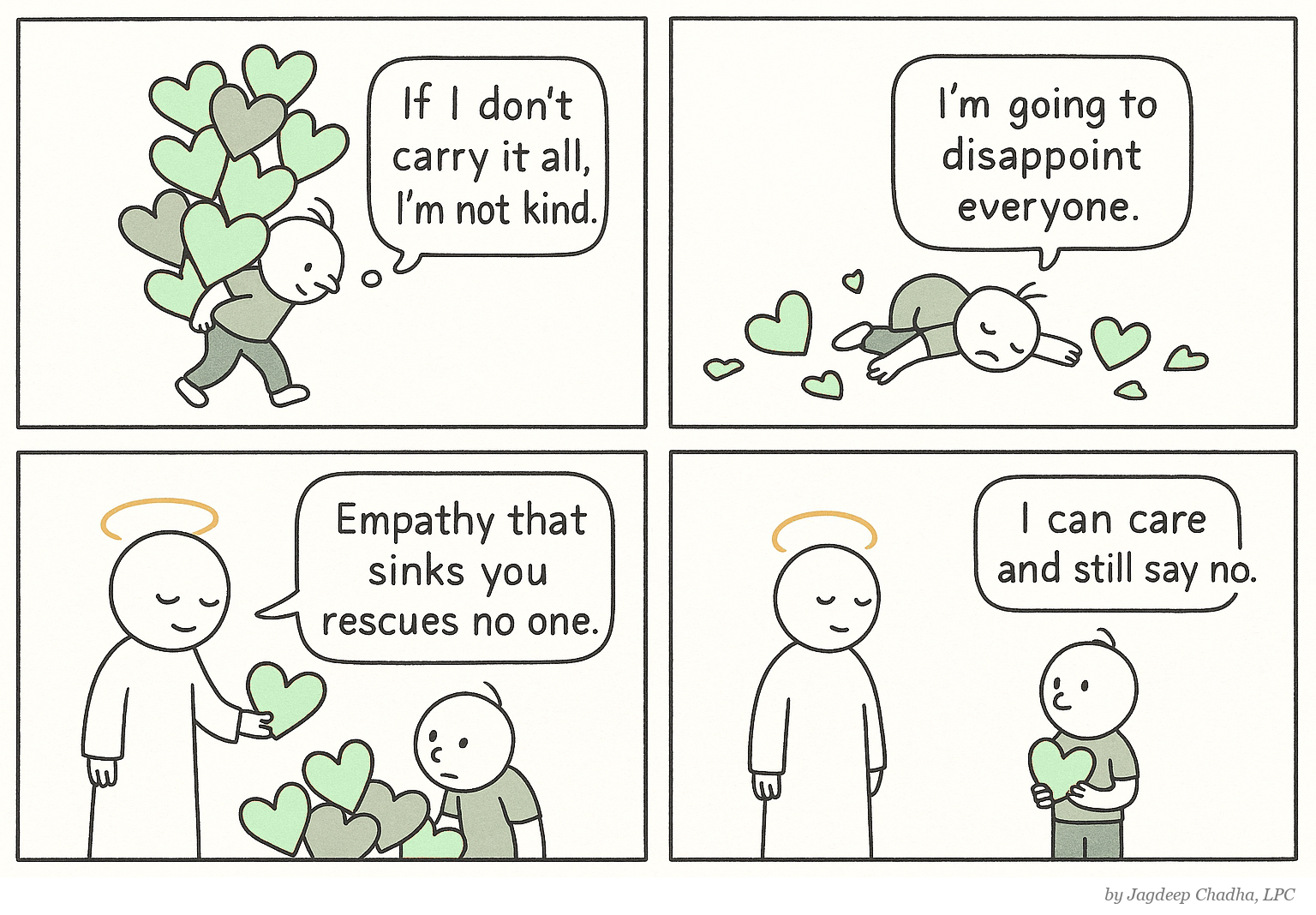
Gad Saad has a provocative phrase for it: suicidal empathy. It’s the title of his 2025 book, and it comes loaded with politics. Strip the politics away and a real clinical truth is sitting underneath it — one I watch play out in my office almost every week.
The claim is simple. Empathy without limits can destroy the person feeling it. Care that has no judgment, no proportion, and no floor under it doesn’t make you a better person. It makes you an unusable one.
I want to make the case carefully, because this idea gets weaponized in both directions. So let me keep it where I actually work: in the room, with real people who are exhausted from caring too much.
The people who burn out first are the kind ones
In my clinical practice, the clients who collapse are rarely the cold or selfish ones. They’re the most caring people I meet. They absorb everyone else’s pain. They carry problems that were never theirs to carry. And they call it kindness.
There’s a belief underneath it, and it’s usually unspoken: If I don’t carry it all, I’m not kind. So they say yes to everything. Saying no feels like a moral failure. They give until there’s nothing left — and then, having given everything, they feel guilty for being empty. They’re convinced they’re about to disappoint everyone.
That’s not love operating at full strength. That’s an emotional leak. And it doesn’t help the people they’re trying to help. Empathy that sinks you rescues no one.
Empathy is a feeling. Compassion is a virtue.
Here’s the distinction I teach, and it’s the heart of the whole thing.
Empathy is a raw feeling — the automatic resonance you get when you sense what someone else is going through. It’s involuntary. It’s valuable. But it is not the finish line.
In my book, I map eleven core virtues, and each one begins as a raw emotion before it’s trained into something durable. Compassion is one of them. Its precursors are curiosity, empathy, and kindness. On its own, empathy is just the raw material. The virtue it’s meant to become is what I call regulated concern — care that stays connected to judgment, proportion, and reality.
The two ask completely different questions. Empathy asks, “What are you feeling?” Compassion asks, “What actually helps here — and what can I sustain?” The first question, left alone, will run you into the ground. The second one keeps you standing long enough to be useful.
Empathy is a stage, not the summit
One of the frameworks in my work traces a progression that most people never realize is a progression at all: pity → sympathy → empathy → compassion.
Pity looks down. Sympathy feels alongside. Empathy climbs all the way inside another person’s experience. And most people stop there, because empathy feels like the deepest form of love available. It isn’t. Compassion is the mature stage — the one that can hold another person’s pain and keep enough distance to actually do something about it.
When empathy never matures into compassion, you get exactly what Saad is pointing at. Feeling that has fused with the other person completely. No judgment left to steer by. No proportion. This is what I’d call a shadow form of the virtue — the raw emotion running the show, ungoverned.
Proportion is the whole discipline
There’s another virtue in my framework that matters here: sacrifice. Real sacrifice — the kind that builds a meaningful life — is chosen and proportional. You decide to give something up, and the cost fits the value you’re serving.
Notice how far that is from what the over-empathizer does. Their sacrifice isn’t chosen; it’s compulsive. It isn’t proportional; it’s total, every time, for everyone. That’s not virtue. That’s the raw emotion of resentment and obligation wearing virtue’s clothes. Proportionality — the same criterion Saad names — is precisely what separates a sustainable act of care from a self-erasing one.
The inner witness is what governs the feeling
So what’s the skill? It isn’t feeling less. I’d never ask a caring person to become colder — that’s not the goal, and it doesn’t work anyway.
The skill is letting the inner witness — the calm, observing voice underneath the reaction — govern the feeling instead of being run by it. The awareness of an emotion is not itself that emotion. The part of you that can notice, “I’m being pulled under here,” is standing on solid ground even when the feeling is a flood. That witnessing space is where empathy gets a chance to become compassion. Feeling without a witness is just weather. Compassion needs somewhere to stand.
This is trainable. It’s most of what therapy actually does — building the internal muscle that can hold a strong feeling without being commanded by it. You learn to stay warm and stay upright at the same time.
You can care and still say no
The line I leave clients with is this one: You can care about someone and still say no.
Those aren’t opposites. Caring and refusing can live in the same sentence, and the word joining them — and — is the entire discipline. “I love you, and I can’t take this on right now.” “I see how much this hurts, and this isn’t mine to fix.” That conjunction is where compassion actually lives.
Boundless empathy isn’t the highest virtue. It’s the raw feeling before the work has been done. Compassion — empathy governed by proportion, judgment, and the inner witness — is what’s left once the work is finished. It’s quieter. It’s steadier. And unlike empathy that has drowned, it can still reach out a hand.
I’m Jagdeep Chadha, LPC, founder of Being Counseling in Houston. In my practice I work with high-functioning professionals — the capable, caring people who tend to give until they’re empty. If you recognize yourself in this, the work is learning to care without being run by it. You can reach out here to start a conversation.
