
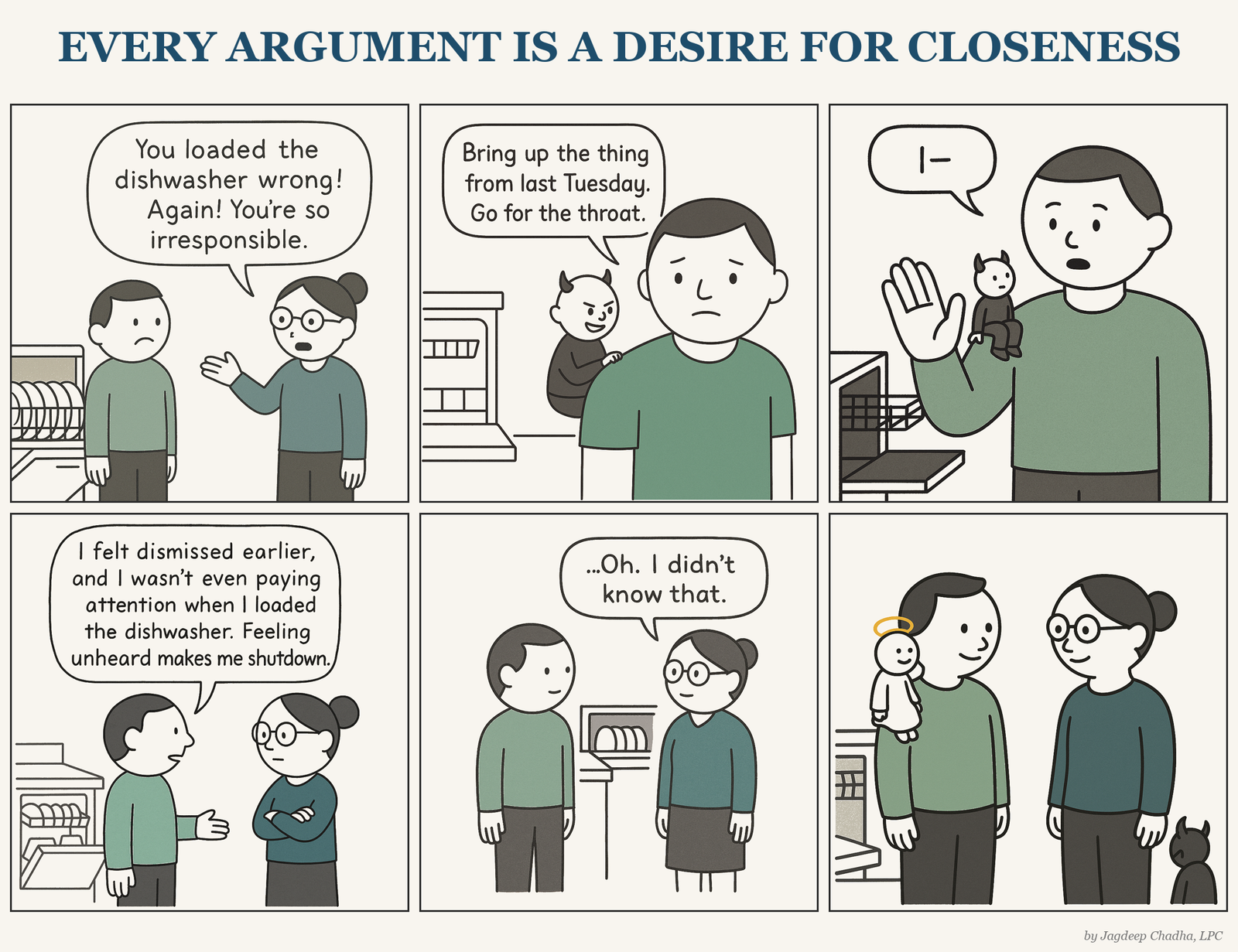
Most fights in a relationship aren’t about the dishes, the money, or who forgot to call the plumber. They’re about distance. Somewhere underneath the argument is a feeling that your partner has drifted out of reach — and arguing, however counterproductive, becomes the way you try to pull them back.
The problem is that fighting from that place rarely works. Negative emotion doesn’t close distance. It usually creates more of it.
In my clinical practice, the couples who repair well aren’t the ones who never disagree — they’re the ones who’ve learned to track two things at once during conflict: their partner’s intention, and their own. That’s a real shift in awareness. It means noticing what your partner is actually reaching for underneath their words, while staying honest about what you’re reaching for underneath yours. Do this consistently, and you start reading your partner accurately — through tone, body language, timing — without needing them to spell everything out.
Identifying your own motivation is the harder half of that work, and the more important one. Motivation isn’t the same as a need. A need is what’s missing — closeness, reassurance, respect. Motivation is the why behind what you’re about to say or do — the actual goal you’re driving toward in that moment, whether it’s to be understood, to protect yourself, to win, or to reconnect. Most people can name what upset them without ever pausing to identify what they’re really trying to accomplish by bringing it up. That’s not something you figure out once and carry forever. It’s a skill, and like any skill, it only develops with repeated practice inside the relationship itself — in the actual moments of friction, not in the abstract.
This isn’t only useful mid-argument. It’s worth building as a habit outside of conflict too — getting used to identifying the intention or motivation behind something you did or said, especially anything that could be misread. Actions and comments rarely land exactly the way you meant them. Left unexplained, your partner’s mind fills the gap — and it usually fills it with a worse story than the truth. Instead of waiting to discover you were misunderstood, get in the practice of naming your own motivation before it becomes a guessing game. It’s a small habit that prevents a lot of arguments before they ever start.
Here’s what that looks like in practice.
- Start by naming your intention. Before you get into the content of the disagreement, say what you actually want out of the conversation. Not what’s wrong with them — what you’re hoping for. This one sentence changes the entire tone of what follows.
- Speak from “I,” not from accusation. Use I-statements and need-statements to say what you’re feeling and what you need. This is harder than it sounds, because the instinct under stress is to assume the worst about your partner’s motives. Notice when you do that. Don’t just correct it — get curious about why you jumped there. That’s usually where the real material is.
- Restate what you heard, and mean it. Active listening only works when it’s driven by real curiosity, not by a script. Don’t assume you already understand your partner’s position. Ask, reflect back, and let yourself be surprised.
- Drop the defense. Defensiveness feels protective in the moment, but it does two things at once: it tells your partner their feelings don’t count, and it invites unrelated grievances into a conversation that was about one specific thing. Nothing gets resolved once that happens.
- Acknowledge the emotion before you try to fix anything. Name what’s in the room — hurt, fear, frustration — before you move to solutions. People don’t feel heard by being fixed. They feel heard by being seen.
- Disagree without erasing the other person’s view. Trade “as a matter of fact” for “have you considered it this way.” One shuts the door. The other keeps two people in the room together.
- Don’t walk back what you meant. This is the one that quietly does the most damage. The moment you have to backtrack a stated intention — “that’s not really what I meant” after the fact — trust erodes. Say what you mean the first time, or don’t say it at all.
None of this makes conflict disappear. Couples who use this framework still disagree, still get frustrated, still have hard weeks. What changes is what the conflict is for. It stops being a contest to win and starts being what it always secretly was: a bid for closeness, made out loud instead of through withdrawal, silence, or anger.
The next time you find yourself mid-argument, ask yourself one question before you say anything else: what am I actually trying to get closer to right now? The answer usually reframes the whole fight.
